DOS
Department of InformaticsDistributed Operating Systems (DOS)
Photo: UHH/Denstorf
1 October 2025
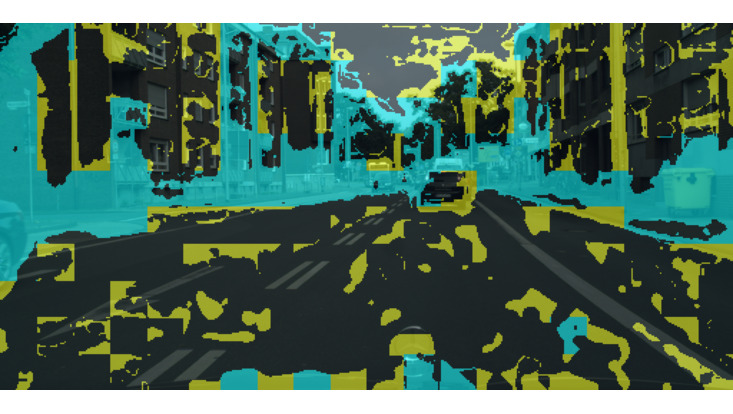
Photo: MC
Real-time semantic segmentation is a key requirement for safety-critical and resource-constrained applications such as autonomous driving. While deep neural networks achieve high segmentation accuracy, their computational demands limit their applicability in real-time settings. Early-exit architectures address this challenge by adapting computational effort to input complexity, allowing confident predictions to terminate inference at intermediate stages.
Recent approaches such as ADP-C enable pixel-wise early exiting for dense prediction by masking confidently classified pixels. However, these methods often produce spatially fragmented masks, limiting their effectiveness. This thesis proposes a spatially aware refinement strategy for pixel-wise early exiting by incorporating region-level information through superpixel and grid-based evaluation. The resulting approach enhances spatial coherence, leading to more structured masks that are better suited for efficient computation, particularly on GPU architectures. Additionally, class-dependent heuristics are explored to further improve prediction accuracy.
Experimental results on semantic segmentation benchmarks demonstrate that incorporating spatial coherence improves mask consistency and increases the size of skippable regions while maintaining comparable accuracy. These findings highlight the importance of spatial structure in adaptive dense prediction and contribute to the development of more computation-efficient semantic segmentation models.
Supervised by:
Prof. Dr. Janick Edinger, Lennart Bengtson