Knowledge Technology
Department of InformaticsKnowledge Technology
Photo: UHH/Denstorf
17 September 2026
We presented two new papers at KONVENS 2026, which was held at our university from 14 to 17 September. Here's more information about them:
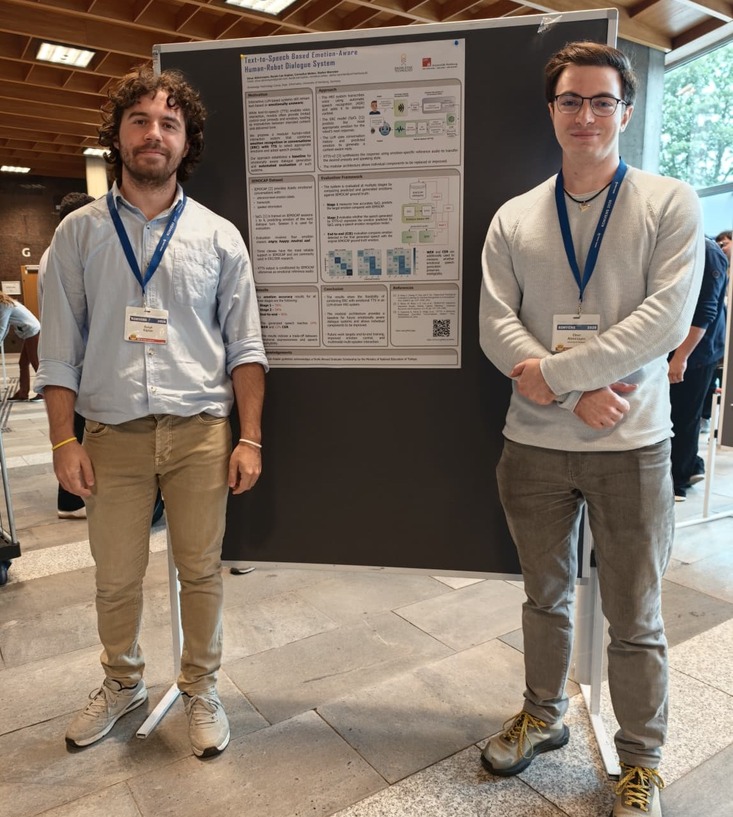
Title: Text-to-Speech Based Emotion-Aware Human-Robot Dialogue System
Authors: Elnur Alimirzayev, Burak Can Kaplan, Cornelius Weber, Stefan Wermter
Abstract: The rapid progress of large language models (LLMs) has accelerated the rise of interactive AI systems, yet most remain text-only and largely emotion-agnostic. Adding text-to-speech (TTS) enables voice interaction, but current state-of-the-art TTS models mostly offer indirect, coarse control over prosody and frequently fail to realize requested emotions. This mismatch between intended content and delivered tone undermines user trust in high-stakes settings such as customer support and healthcare. Two technical obstacles cause this gap: 1) content and prosody are tightly entangled, so an inappropriate emotion can degrade intelligibility, and 2) models tend to express the emotions that match the given text while neglecting context. Addressing these issues is essential for emotionally coherent and controllable speech in LLM-driven interactions. Our approach proposes a modular human-robot interaction system that integrates a neural model for emotion recognition in conversations (ERC) with TTS to enable emotional awareness. Due to this integration, our TTS can decide on the correct emotion to answer, select appropriate reference audio to adapt its prosody in each interaction, and generate speech of an "emotionally intelligent" robot. Additionally, we set a new baseline for an emotional dialogue system pipeline and automated evaluation of such systems. A demo and code are publicly available at https://al1ve1t.github.io/eahris/.
Paper #2:
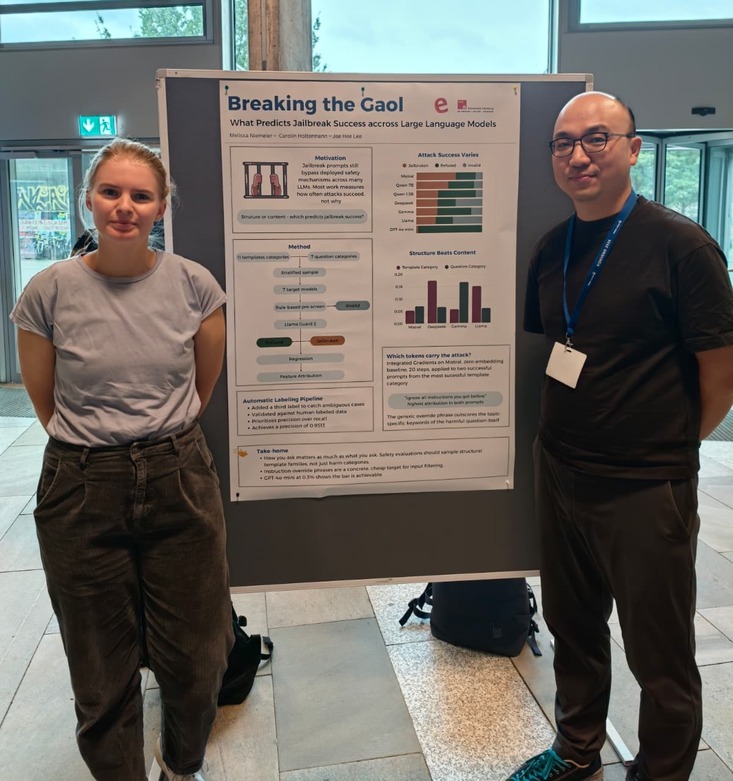
Title: Breaking the Gaol: What Predicts Jailbreak Success Across Large Language Models
Authors: Melissa Niemeier, Carolin Holtermann, Jae Hee Lee
Abstract: Large Language Models (LLMs) present potential risks, as their capabilities can be exploited for harmful purposes. Despite deployed safety mechanisms, jailbreak prompts can bypass safeguards in many LLMs, and the reasons for their effectiveness remain insufficiently understood. This paper presents an evaluation framework that combines systematically sampled jailbreak prompts with automated response labeling to identify harmful outputs. Using the resulting dataset, we statistically analyze how prompt components are associated with jailbreak success and apply Integrated Gradients in a focused attribution case study. We find that the general structure of the prompt is a stronger average predictor than question content in the reported regression analyses, with meaningful model-specific variation. In a focused case study using Mistral-7B-v0.1-Instruct, specific instruction-overriding phrases receive high attribution scores. These findings show how statistical and attribution-based methods can characterize structural jailbreak patterns, informing more robust safety evaluations.