Knowledge Technology
Department of InformaticsKnowledge Technology
Photo: UHH/Denstorf
17 September 2026
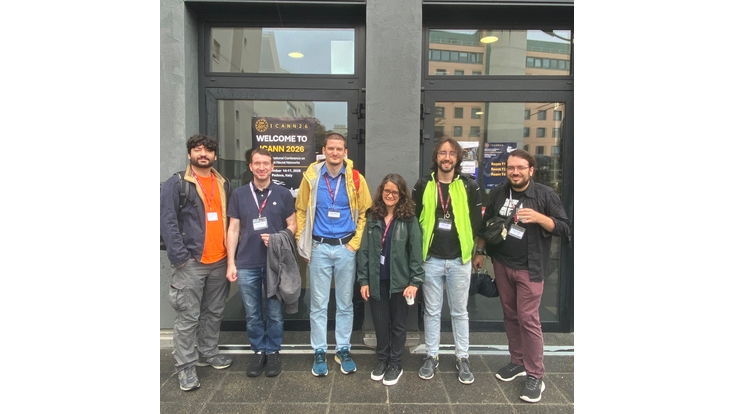
Photo: UHH Knowledge Technology
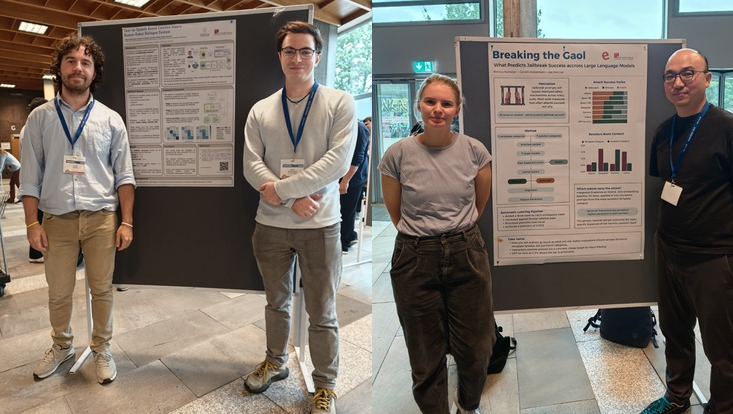
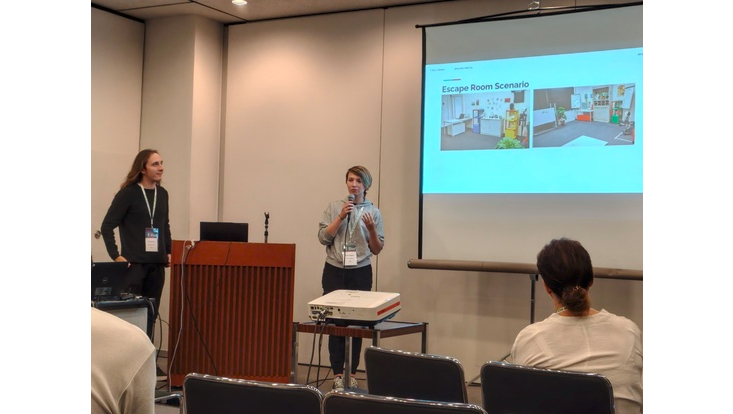
Our group participated in ICANN 2026 in Padova, Italy, with two paper presentations, by Philipp Allgeuer and Sergio Lanza, and a workshop that we organized. Connor Gäde, Mathias Kerzel, Mariana Barros and Parsa Mastouri presented their work at the workshop. Here are some details on the papers:
Authors: Philipp Allgeuer, Jan-Gerrit Habekost, Stefan Wermter
Abstract: Robots operating in real-world environments must in general be able to recognize previously unseen objects. As robotic systems move toward open-world autonomy, there is a growing, yet largely unmet, need for open vocabulary object detectors that are prompt-free and efficient enough for continuous deployment. We present AnomNOVIC, a two-stage known-workspace framework that combines a masked autoencoder (MAE) trained for anomaly detection, with NOVIC, a powerful real-time prompt-free open vocabulary image classifier. The MAE produces generic object-agnostic bounding boxes, allowing NOVIC to classify salient image regions without requiring a predefined candidate class list. We evaluate AnomNOVIC against strong open vocabulary baselines in a tabletop robot-object environment featuring the NICOL humanoid robot, reaching 47.1% AP / 57.5% AP50 for prompt-free recognition, and 59.0% AP / 72.5% AP50 if class candidates are provided. Across additional datasets, including an in-the-wild test set with 48 unique objects, AnomNOVIC reaches up to 82.6% prompt-free detection and classification accuracy. These results significantly surpass all tested open vocabulary baselines, including YOLO-World-v2, OWLv2, and YOLOE.
Paper #2:
Title: Extraction and Analysis of Multimodal Concepts in Vision Language Models through Sparse Autoencoders
Authors: Sergio Lanza, Jae Hee Lee, Stefan Wermter
Abstract: Vision Language Models (VLMs) have demonstrated impressive performance in tasks requiring joint understanding of images and text, such as image captioning and Visual Question Answering (VQA), but our understanding of their internal processes remains limited. Recently, Sparse Autoencoders (SAEs) have emerged as a promising tool to support the interpretation of concepts encoded in VLMs. However, most SAE-based approaches focus only on textual or visual concepts separately, ignoring multimodal concepts. This limitation hinders a comprehensive understanding of VLMs, since concepts that integrate both modalities can be misclassified. Moreover, previous visual approaches often produce low-quality visual concept descriptions that are vague or incomplete, limiting their usefulness for understanding model reasoning. We propose a framework based on SAEs to extract and analyze visual, textual, and multimodal concepts from VLMs. For each neuron, we propose a candidate human-interpretable concept and compute the alignment between the concept and the dataset samples using cosine similarity scores. Experiments on a VQA dataset (LLaVA-NeXT) demonstrate that our framework improves visual concept quality by up to 45\% compared to existing SAE-based methods, while maintaining high textual concept quality and enabling systematic identification of multimodal concepts. This work contributes new insights into the conceptual space of VLMs, providing a structured approach to distinguish between visual, textual, and multimodal concepts. The code is available at https://github.com/PHDLanza/Multidata_SAE.