Knowledge Technology
Department of InformaticsKnowledge Technology
Photo: UHH/Denstorf
1 October 2026
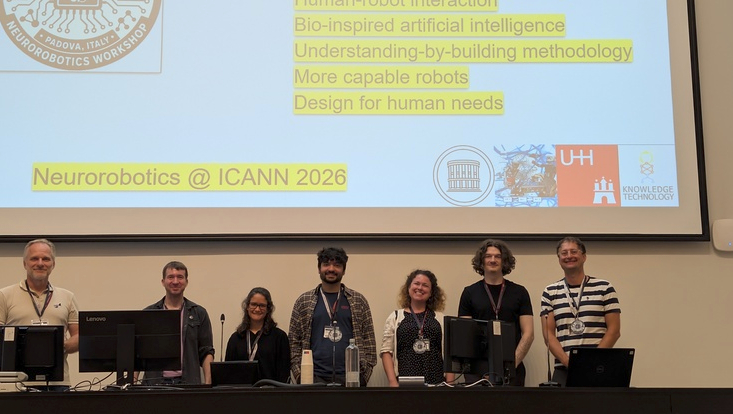
4th Neurorobotics Workshop at ICANN 2026
On 14 September 2026, the 4th Neurorobotics Workshop took place at the 35th International Conference on Artificial Neural Networks (ICANN 2026) in Padua, Italy. The workshop brought together research from machine learning, robotics, cognitive science, human-robot interaction, and bio-inspired artificial intelligence. It continued a series of three previous Neurorobotics special sessions held at previous ICANN conferences.
The workshop was organized by Stefan Wermter, Igor Farkaš, Kristína Malinovská, Matthias Kerzel, Jan-Gerrit Habekost, Miroslav Cibula, and Hassan Ali from the University of Hamburg and Comenius University in Bratislava. The scientific programme featured six presentations covering topics such as monocular depth estimation for robotics, task-sufficient active perception, vision-language-action models, bio-inspired trajectory planning, sim-to-real transfer, and motion primitive discovery.
The workshop concluded with a 30-minute closing colloquium chaired by Matthias Kerzel, providing an opportunity to discuss common challenges and future directions in neurorobotics, cognitive robotics, and human-robot interaction.
Link: https://cogsci.fmph.uniba.sk/neurorobotics-ws/
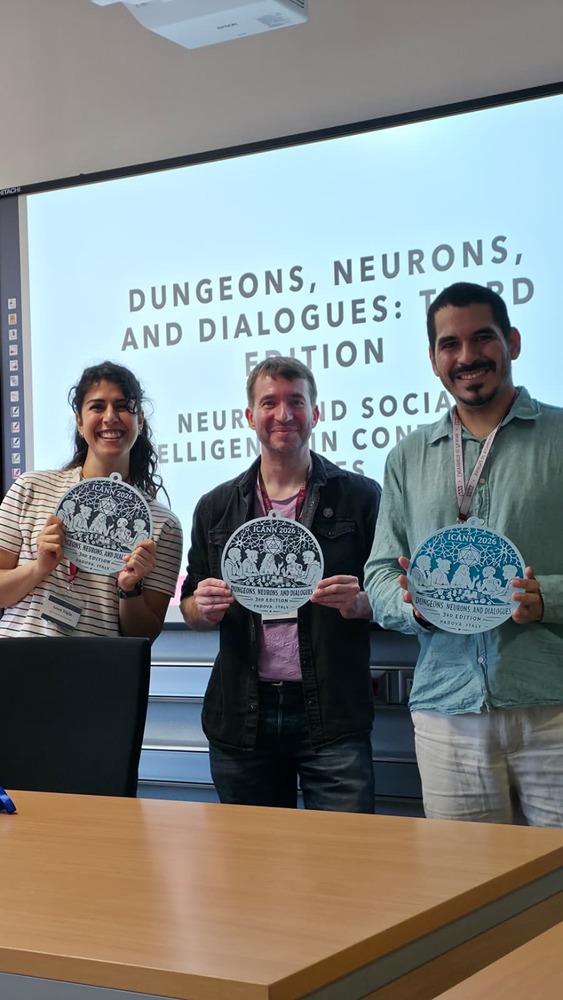
Dungeons, Neurons, and Dialogues Workshop at ICANN 2026
On 14 September 2026, the third edition of the workshop Dungeons, Neurons, and Dialogues: Neural and Social Intelligence in Contextual Games took place at the ICANN 2026. The workshop explored role-playing and other contextual games as experimental environments for studying social intelligence, adaptive behaviour, dialogue, cooperation, and human-AI interaction.
The workshop was organized by Pablo Barros, Laura Triglia, Nikhil Churamani, Matthias Kerzel, and Pietro Gravino, representing the University of Pernambuco, the Italian Institute of Technology, the University of Cambridge, the University of Hamburg, and Sony CSL Paris. It continued the workshop series following previous editions at ACII 2024 and HRI 2025.
The programme featured an invited talk by Dr. Leticia Berto from the University of Manchester, From Learning to Teamwork: Toward Cognitive Robots That Grow, Adapt, and Collaborate, addressing intrinsically motivated learning, adaptive behaviour, social interaction, and robot-robot collaboration. In addition, two accepted papers were presented, focusing on computational models of player motivation in tabletop games and sim-to-real game-state detection for the Chef’s Hat card game.
By bringing together perspectives from neural computation, cognitive modelling, game AI, robotics, and human-AI interaction, the workshop highlighted how games can serve as controlled but socially rich environments for investigating increasingly adaptive and socially aware artificial agents.
Link: https://dnd-sidc.github.io/
Talks by Knowledge Technology and Alumni at IIT Genoa
On 18 September 2026, Matthias Kerzel from the Knowledge Technology group and former group member Pablo Barros visited the Italian Institute of Technology (IIT) in Genoa and gave talks on neuro-cognitive robotics and adaptive cognitive agents. Pablo Barros, a former member of the Knowledge Technology group, gave the talk entitled Somebody That I Used to Know: Memory, Narrative Identity, and Adaptive Agents That Make Spectacular Decisions. He presented an agentic architecture, where personas are generated from narrative observations rather than represented as static prompts. His talk focused on how memories, relationships, actions, conflicts, emotions, and previous decisions can shape an agent’s identity and influence its future behaviour.
Matthias Kerzel presented NICO & NICOL: Developing Research Platforms for Neuro-Cognitive Robotics. The talk traced the development from NICO, the Neuro-Inspired Companion, and its developmental robotics and neuro-cognitive foundations to the larger NICOL platform and current work on agentic and vision-language-model-driven robot control. Selected examples covered embodied learning, perception, object manipulation, and human-robot interaction, while also highlighting methods, datasets, models, and other resources that can be used independently of the specific robot platforms.
Together, the talks highlighted complementary perspectives on embodied and adaptive artificial agents, ranging from robotic interaction with the physical world to memory, narrative identity, and decision-making.