Knowledge Technology
Department of InformaticsKnowledge Technology
Photo: UHH/Denstorf
2 October 2026
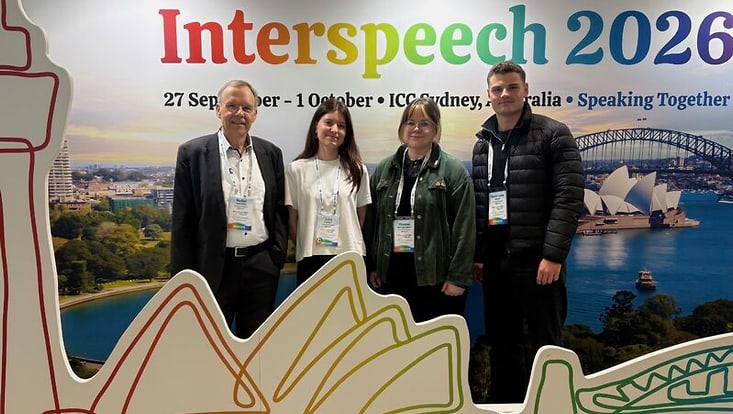
Photo: UHH Knowledge Technology
Our group presented three papers at Interspeech 2026 in Sydney, Australia. Congratulations to our members who presented new research on robust speech recognition and continual learning. Here is an overview of our papers:
Title: MoDiCoL: A Modular Diagnostic Continual Learning Dataset for Robust Speech Recognition
Authors: Theresa Pekarek-Rosin, Matthias Kerzel, and Stefan Wermter
Abstract: Modern Automatic Speech Recognition (ASR) systems have made remarkable progress on standard benchmarks, yet performance gaps have emerged under real-world distribution shifts, caused by recording conditions, accents, speech impairments, and noise. Existing datasets and benchmarks typically isolate these factors, which overlooks their co-occurrence in real-world applications. In this paper, we argue that model robustness can be treated as a dynamic capability that continually develops, and we introduce MoDiCoL, a Modular Diagnostic Continual Learning dataset designed for controlled analysis of linguistic content, speaker characteristics, and acoustic environments. Furthermore, we propose a real-world-inspired continual learning curriculum to simulate incremental updates and study how robustness is acquired, transferred, and forgotten. We evaluate three continual learning strategies and provide detailed insights into robustness under evolving conditions.
Paper #2
Title: Learning to Hear Hesitation: Continual Learning for Disfluency-Aware ASR
Authors: Henri-Leon Kordt, Theresa Pekarek-Rosin, Jae Hee Lee, and Stefan Wermter
Abstract: Despite advances in large-scale Automatic Speech Recognition (ASR), disfluent speech remains challenging, as state-of-the-art systems are often optimized to omit disfluencies, leading to information loss and hallucinations. Prior work has focused on verbatim transcription and the integration of disfluency markers, but adapting models on limited datasets can lead to catastrophic forgetting of general-domain knowledge. We address this gap by leveraging continual learning (CL) with explicit disfluency tokens. We first introduce these tokens into a pretrained ASR model to establish stable token mechanisms, and then continue training on additional datasets with varying disfluency distributions. Through a detailed analysis of model dynamics during training, we identify a trade-off between marker learning and ASR performance, and a consistent cross-attention head mechanism shared across CL methods.
Paper #3
Title: A Generalized Formalism of Auto-Regressive Decoding for Speech Processing
Authors: Julia Gachot, Philipp Allgeuer, Marie S. Bauer, and Stefan Wermter
Abstract: In speech processing, most state-of-the-art sequence prediction models rely on auto-regressive (AR) strategies to generate output sequences based on the raw predictions of the model. Despite their crucial role in the inference process, a comprehensive overview of AR strategies as a unified field is lacking, due largely to implicit and multiple definitions of next-token decoding. This context complicates the choice, comparison, and evaluation of strategies, while creating inconsistencies in the characterization of approaches as auto-regressive or not. We begin by setting explicit inclusion criteria for the field of AR search in speech processing, and derive a generalized theoretical framework to categorize and report on search strategies for neural models. We show the capabilities of this formalism in simplifying the design of benchmarks centered around the decoding process, allowing for ablation studies that are focused on search strategies.