
Bachelor Project WS 25/26
MCI Projekt 25/26: Nachhaltigkeit
Ziele und Motivation
In diesem Jahr ging es in unserem Bachelorprojekt um Nachhaltigkeit. Fünf Gruppen untersuchten hierbei verschiedene Fragestellungen, die mit den UN Sustanability Goals zusammenhängen.
Supervision
Mixing potions in VR: Examining the effects of different visual cues on cognition
Thema
Wir haben uns mit den Effekten auf die Kognition zweier verschiedener Navigationshinweise in VR beschäftigt. Dafür haben wir eine Anwendung entwickelt, in der Studienteilnehmende in einer virtuellen Umgebung Tränke entsprechend verschiedener Rezepte mischen konnten.

Vorgehen
Zunächst haben wir die Versuchspersonen gebeten, einen Trainingsraum zu erkunden, damit sie sich mit den benötigten Bewegungsabläufen, den interaktiven Objekten und der Umgebung vertraut machen konnten. Die Teilnehmenden befanden sich in einem Studierzimmer. Vor sich sahen sie einen Tisch sowie drei Regalbretter mit verschiedenen Flaschen, welche mittels VR Controller gegriffen werden konnten. Die Flaschen sollten in den auf dem Tisch befindlichen Kessel gelegt werden. Wichtig waren die insgesamt 25 verschiedenen Symbole auf den Flaschen. Rechts neben den Versuchspersonen befand sich ein roter Knopf, welcher dafür sorgt, dass alle Flaschen wieder an ihren Positionen im Regal erscheinen. Diesen haben wir implementiert, damit heruntergefallene Flaschen leicht wieder zugänglich gemacht werden können. In der Anwendung selbst wurden dann nacheinander zwei verschiedene Anleitungen gezeigt. Die ersten sieben Rezepte wurden alle mittels derselben Anleitung erfüllt und die darauffolgenden sieben mittels der anderen. Mit Welcher Anleitung die teilnehmende Person beginnt, wurde dabei zufällig entschieden. Pro Rezept wurden sieben Flaschen benötigt. Ob die hineingeworfene Flasche richtig war, wurde mittels eines grünen Hakens oder eines roten X gezeigt, welches über dem Kessel nach Einwurf der Flasche erschien. In einer Anleitung wurden die benötigten Flaschen durch eine visuelle Hervorhebung angezeigt. Die Flaschen sind hierbei von einem hellen Lichtschein umgeben und leuchten. In der anderen Bedingung erhalten die Teilnehmenden stets Bilder auf einer Tafel links über dem Tisch, die Ihnen zeigen, welche Flasche aktuell im Rezept benötigt wird. Nachdem jeweils eine Bedingung abgeschlossen war, wurde ein abschließender Fragebogen bzgl. der Motivation, der Arbeitsbelastung, des Autonomieempfindens sowie der Erinnerungen an einzelne Flaschen und eine Selbsteinschätzung dies bezüglich ausgefüllt.
Ergebnisse
Für Motivation, Arbeitsbelastung und wahrgenommene Autonomie konnten wir zwischen den Bedingungen keine signifikanten Unterschiede in unserer Studie feststellen. Aber tatsächlich war die Anzahl korrekt erinnerter Flaschen in der Bild Anleitungsbedingung signifikant höher, sodass wir weitere Evidenz dafür gefunden haben, dass eine komplexere Suche durchaus zu besserem Lernen führen kann als eine Suche mit salienten cues.
Projekt Team
- Lina Kuri
- Ariane Plückhahn
- Anna Richter
VR als ultimatives Empathie-Medium?
Unser Thema
Im Rahmen des diesjährigen MCI Projekts (WiSe 25/26) wollten wir untersuchen, inwiefern eine VR-Anwendung geeignet ist, um Empathie bei den Nutzenden auszulösen.
Dafür haben wir eine selbst entwickelte VR-Intervention mit einem ebenfalls selbst erstellten 2D-Video zum Thema "Arbeitsbedingungen in der Textilindustrie" verglichen.
Gerade VR scheint auf den ersten Blick für die Empathievermittlung ein besonders geeignetes Medium zu sein, da sie es ermöglicht, Situationen aus unterschiedlichen virtuellen Perspektiven unmittelbar zu erleben. Gerade solch eine Perspektivübernahme gilt als zentraler Aspekt von Empathie. Gleichzeitig ist die Entwicklung einer VR-Anwendung mit erheblichem Mehraufwand im Vergleich zu einem Video verbunden. Deswegen ist eine wissenschaftliche Prüfung der Annahme von VR als Empathie-Medium relevant.
Implementation & Studie
Zur Darstellung verschiedener Arbeitsbedingungen in der Textilindustrie haben wir uns der Metapher eines Hochhauses bedient. Jede Etage dieses Hochhauses repräsentiert dabei einen zentralen Abschnitt innerhalb der Lieferkette der Textilindustrie und zeigt Personen bei der Ausführung ihrer jeweiligen Tätigkeit. In der VR-Anwendung wurden dann zusätzliche Informationen zu den prekären Arbeitsbedingungen in der Textilindustrie über Audiospuren vermittelt, welche sich aktivieren ließen, indem man einen auf dem Boden hervorgehobenen Ring betrat. Das Video bestand letztendlich aus Kamerafahrten aus unserer in Unity entwickelten virtuellen Umgebung. Auch hier wurden die Informationen durch eine im Hintergrund laufende Audiospur vermittelt.
Unsere Studie hatte letztendlich 34 Teilnehmende in einem Within-Subject-Design, alle Personen durchliefen also sowohl die VR- als auch die Video-Kondition. Im Anschluss der jeweiligen Kondition füllten die Teilnehmenden einen Fragebogen aus, indem Empathie-Maße sowie qualitatives Feedback erhoben wurden.
Ergebnisse
Die Auswertung unserer Studie ergab keinen signifikanten Unterschied bezüglich der abgefragten Empathie-Maße. Dies könnte jedoch darauf zurückgeführt werden, dass die meisten Teilnehmenden noch wenig Erfahrung mit VR-Anwendungen hatten und der Neuheits- sowie Spaßfaktor daher zu Ablenkung führte. So wurde es nämlich teilweise im qualitativen Feedback berichtet.
Spannend ist zudem, dass die Versuchspersonen nach der VR-Kondition zumindest deutlich öfters von einer höheren Absicht berichteten, ihr Kaufverhalten in der Zukunft zu ändern.
Insgesamt passen unsere Ergebnisse damit zur aktuellen Studienlage zu diesem Thema, welche ebenfalls durchmischt ist.
Projekt Team
- Philipp Diester
- Elias Lonhard
- Cedric Zimmermann
----------------------
Immersive Time Travel
Exploring Connection to Nature
Motivation
Climate change is one of the most pressing challenges of our time, with consequences such as deforestation, species extinction, and ecosystem degradation becoming increasingly visible and severe. Despite the overwhelming scientific consensus on the reality and urgency of climate change, a significant gap remains between awareness and action. Research suggests that one reason for this gap is that environmental degradation is often not directly or immediately observable, leading individuals to perceive climate change as a distant threat. Extreme weather events are becoming more frequent and intense due to climate change, yet subjective attribution of these events to climate change---rather than mere exposure---appears to be a key predictor of climate policy support across the world. Furthermore, for much of the population, climate change appears as a slow, gradual shift in daily weather, leading many to perceive its impacts as minor and resulting in apathy. Immersive virtual reality (VR) technologies offer a novel opportunity to transform how individuals experience climate change. By allowing users to witness environmental degradation firsthand through simulated time travel---experiencing a landscape across past, present, and future---VR may reduce psychological distance and foster a deeper emotional connection to nature. This study explores the potential of immersive time travel in virtual reality as a tool for fostering emotional connection to nature. The central research question guiding this investigation is: To what extent does experiencing the consequences of climate change through a simulated time travel in virtual reality influence participants' perception and understanding of climate change impacts compared to traditional representations such as photography and audio?
Procedure
After completing a short demographic questionnaire (assessing age, gender, and prior VR experience), participants fill out the first set of baseline measures. The Inclusion of Nature in Self (INS) measures cognitive connectedness between self and nature. Issue Involvement assesses perceived personal relevance of climate change. The Climate Change Attitude Survey (CCAS) consists of Likert-type items capturing two subscales: Beliefs about climate change and Intentions to act. Additionally, participants complete the Carbon Footprint Calculation using the WWF Climate Calculator, an online tool that estimates emissions across food, travel, home, and consumption modules. Following this baseline assessment, participants experience the first condition (either immersive VR or the traditional control presentation). Immediately afterward, they complete the same set of questionnaires again to measure immediate changes. In addition, they complete the Interest/Enjoyment and Value/Usefulness subscales of the Intrinsic Motivation Inventory (IMI) to assess how they experienced the activity, as well as the immersion subscale of the Player Experience Inventory (PXI) to measure their sense of immersion in the virtual world (slightly modified to fit this study). Participants then proceed to the second condition and, after completing it, fill out all questionnaires once more. Finally, they answer several open-ended questions, including two questions about the content of the VR scenes, one question about which condition they preferred and why, and a final space for additional comments.
Conditions
During both conditions there is an audio text. These two texts are mostly identical and only differ in specific words. In the VR Condition Participants are asked to take a photo and in the Traditional Audiovisual condition they are at the same time in the audio asked to look at the Photo.
Traditional audiovisual narrative Condition
In this condition participants listen to an audio file which is 3:29 minutes long. This includes some silent sections, during which the participants are told to view some photographs displayed below (representing 'Past', 'Present' and 'Future').


Virtual reality Condition
During this condition participants upon wearing the head mounted display land in a virtual reality environment. The participant appears beside a lake with a big stone on one side, beside that a wooden information board with the Year 2026 at the top. Between the participant and the lake is a grey stele with a big red start button on top and on the opposite site to the stone is bank with an Grandfather figure sitting on it. Between the participant and the Stone is a tripod with a camera on top. The participants can grab the camera with their hands and make photos that appear on the wooden board by pressing the button ontop of the camera. The participants were given some time to familiarize themselves with the environment. They could move in the VR-environment by moving their real body in an area walled of by the boundary function of the head mounted display. We also asked them to try taking the camera and making a photo to make sure it is within the boundary. Afterwards they where asked to press the start button when ready. Upon pressing the button the Grandfather starts narrating about the winter and after some time a time travel to the year 1976 is simulated by changing the environment a wintery one with snowy trees and mountains, a frozen lake and snow that is about knee high and changing the year on the wooden board. Also the Grandfather vanishes as he didn’t accompany the participant in the time travel. Now the Grandfather continues and asks you to take a picture to show him. After taking a picture and putting the camera back on the tripod the participant travels back to 2026, which is shown by reversing all the changes of the timetravel. The Grandfather continues and again asks the participant to take another picture. After putting the camera away again, the participant time travels again, this time to the future. This is again shown by a changing environment. Some trees start falling, the lake shrinks and the atmosphere gets hot and gets a orange red hue, the Grandfather disappears again and the year on the wooden board changes to 2076. The Grandfather starts talking again and asks the participant to take a Photo again. Putting the camera on the tripod afterwards triggers the timetravel back to 2026 which changes the environment back to normal again. After some last words from the Grandfather the participants are asked to take of the head mounted display


Results
In summary, the results support the notion that both immersive VR and traditional narratives can be effective tools for promoting issue involvement and pro-environmental behavioral intentions. The added value of VR lies in its ability to create a more engaging and motivating experience, which may be beneficial for sustaining attention and encouraging repeated engagement in educational contexts. Future research should explore whether repeated VR exposures or more prolonged immersive experiences might yield stronger effects on deeper constructs such as nature connectedness and climate change beliefs
Project Team
- Janis-Lukas Franken
- Ipke Hansen
- Leon Kiehn Mejias
- Johannes Klar
Vektorraum
Untersuchung des Einflusses von Narration auf die intrinsische Motivation von Nutzenden einer VR-Lernanwendung
Motivation
Gamification stellt eine etablierte Möglichkeit dar, Menschen während der Bearbeitung von Aufgaben zu motivieren. Doch welche Elemente der Gamification sind es, bei deren Einsatz eine höhere Motivation festgestellt werden kann? Im Rahmen des HCI-Bachelorprojekts 25/26 haben wir die VR-Lernanwendung Vektorraum entwickelt, mit der Vektoraddition und Skalarmultiplikation geübt werden können. Innerhalb dieser Lernanwendung haben wir das Element der Narration in einer Studie mit 30 Teilnehmenden in Hinblick auf intrinsische Motivation, Arbeitslast und Präsenzerleben untersucht.
Methodik
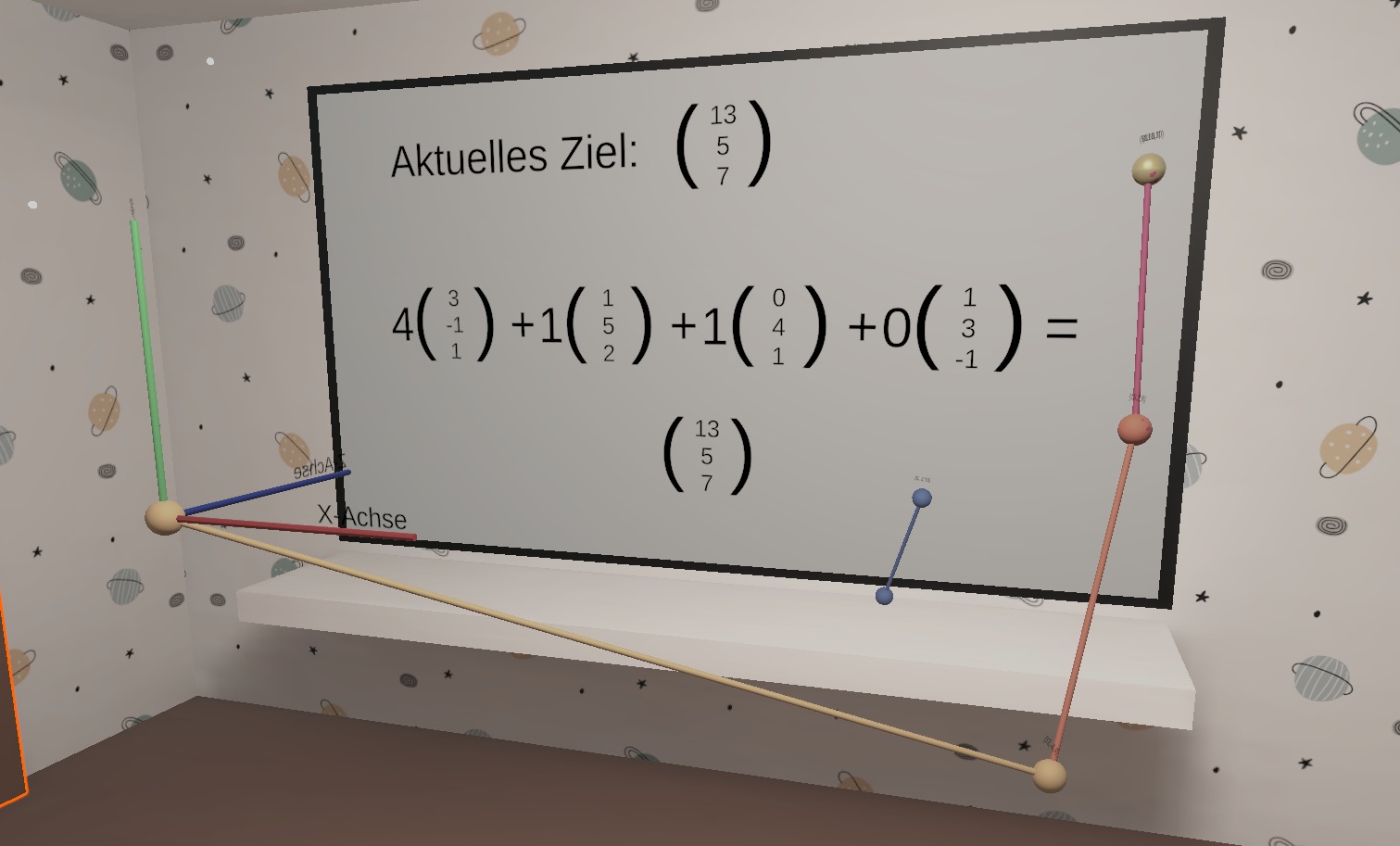
Vektorraum wurde mit der Unity Engine (Version 6000.0.060f1) für das VR-Headset Meta Quest 3 entwickelt. In der VR-Anwendung befinden sich Spieler:innen in einem Kinderzimmer. Die Aufgabe besteht darin, mit gegebenen Vektoren einen Pfad zu einem gegebenen Ziel zu bauen. Hierfür müssen die passenden Vektoren ausgesucht, addiert und in manchen Fällen auch durch Skalarmultiplikation verlängert werden. Innerhalb der Anwendung wird dies durch das Greifen und Platzieren der Vektoren in einem Koordinatensystem sowie das Verlängern der Vektoren durch Knopfdruck umgesetzt.

Studie
Um den Einfluss der Narration zu untersuchen, haben wir Vektorraum in zwei Versionen (mit Narration, ohne Narration) umgesetzt und eine Studie im Within-Subject-Design durchgeführt. In der Kondition mit Narration werden Spieler:innen von einem Alien namens Glorp gebeten, dabei zu helfen, Proben zu sammeln. Glorp erklärt zudem, dass nur Flugmanöver entlang bestimmter Vektoren möglich seien. In der Kondition ohne Narration wird dagegen ausschließlich das Ziel und die Funktionsweise der Anwendung kommuniziert.

Für die Erfassung der intrinsischen Motivation haben wir dieKurzskala Intrinsische Motivation (KIM) verwendet. Zusätzlich haben wir die wahrgenommene Arbeitslast mithilfe desNASA-TLX und das erlebte Präsenzgefühl innerhalb der Anwendung durch denigroup presence questionnaire (IPQ) erhoben. Außerdem wurden die Teilnehmenden gefragt, welche Version vonVektorraum sie bevorzugen und warum.
Ergebnisse
Wir konnten innerhalb unserer Studie keinen signifikanten Unterschied in der intrinsischen Motivation und im Präsenzerleben der Gruppen beobachten. Die Arbeitslast war in der Kondition mit Narration signifikant höher. Bei der Frage welche Version sie präferieren, nannte ein Großteil der Teilnehmenden die Variante mit Narration. Diese Ergebnisse deuten darauf hin, dass eine sehr simple Einbettung in ein Narrativ allein nicht ausreicht, um die intrinsische Motivation zu steigern, auch wenn diese Kondition von den Teilnehmenden mehrheitlich bevorzugt wurde.
Projekt Team
- Lisa Belz
- Julia Pamperien
- Rufus Schröder
Immersive and Traditional Learning Methods
Learning Experience in Virtual Reality vs. Worksheets Using the Example of Cell Biology
Idea and Motivation
In recent years, digitalization has found its way into schools, changing how students engage with learning materials. While devices such as tablets are already widely used in classrooms, virtual reality headsets are still rarely seen, despite their potential to enable immersive and active learning experiences. This raises the question of whether learning with VR can be more effective than traditional methods such as worksheets.
Existing research on this topic has produced mixed results and often relies on between-subject designs, which does not account for individual differences in learning abilities. With our project, we aim to investigate to what extent VR can enhance learning outcomes compared to conventional worksheets by focusing on a within-subject design. This approach allows us to better consider interpersonal differences, as each participant experiences both conditions.
Implementation
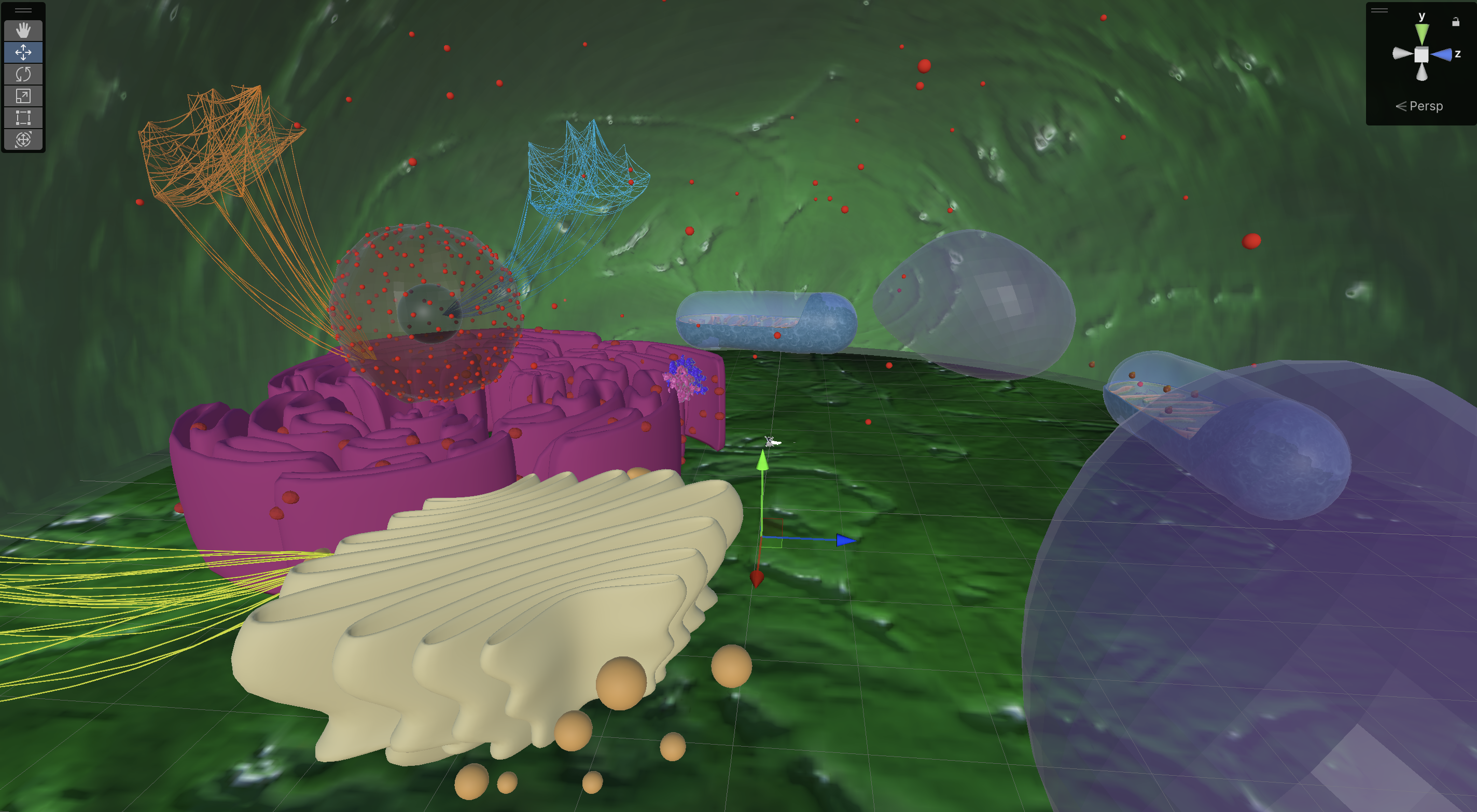
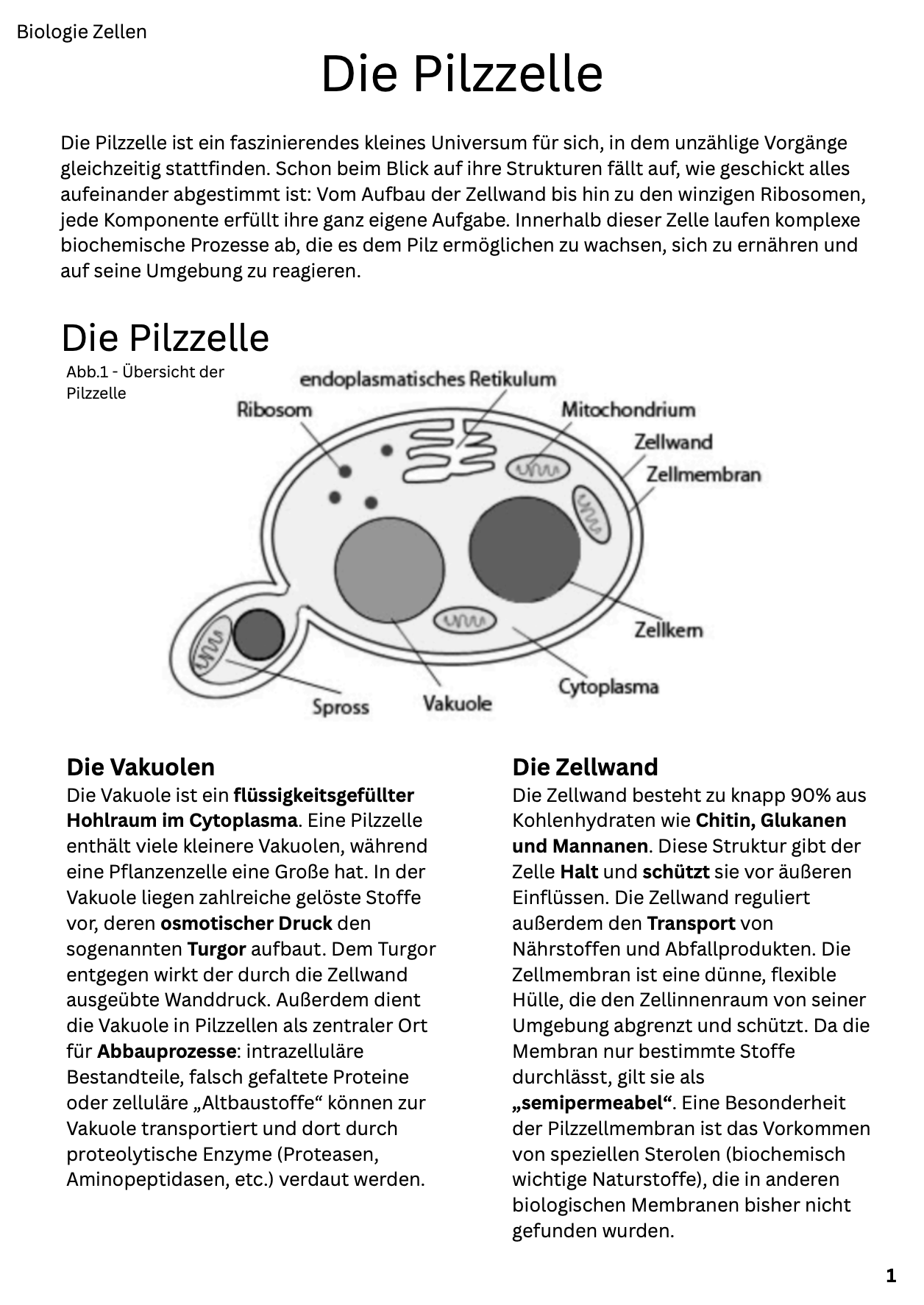
To implement this, we selected two topics of comparable difficulty: the structure of a fungal cell and the structure of a cell nucleus. For each topic, we developed a VR environment, a worksheet, and a knowledge quiz to measure learning performance. In addition, we examined cognitive workload and intrinsic motivation using established questionnaires such as the NASA TLX, the Intrinsic Motivation Inventory, and the User Experience Questionnaire. During the study, each participant interacted with one topic in VR (e.g. the cell nucleus) and completed a worksheet on the other topic (e.g. the fungal cell), allowing us to directly compare both learning methods within the same individual.
To implement the VR environment, we used Unity. The scenes for both the fungal cell and the cell nucleus were mostly created by ourselves, with only a small number of additional assets sourced externally. Navigation within the environment is enabled through a teleportation SDK, while interaction is based on a custom designed mechanic: users can touch interactive spheres, which trigger a textbox displaying the corresponding information (identical to the content provided in the worksheet). In addition, an audio feature allows the text to be read aloud, giving users greater flexibility in how they engage with the material. For selected elements we also incorporated animations to take advantage of VR’s ability to visually represent dynamic processes within the structures. To ensure a smooth introduction to these interaction techniques, we included a dedicated tutorial scene that familiarizes users with the controls and features before they begin the actual learning experience.



Results
In a direct comparison of learning success, the worksheets perform significantly better compared to the VR condition. Participants also felt more competent after the worksheet. At the same time, VR still seems to have great advantages in the area of intrinsic motivation, as participants simply enjoyed the VR condition more. Additionally, participants reported a higher Workload in the VR condition. But, as most of them were not familiar with navigation in Virtual Reality Environments, results might change if tested on more VR-experienced participants.


Project Team
- Elmar Albert
- Malena Lembke
- Nika Vladimirski
- David Jakob Winter