
Interactive Game Development 2026
This semester, our Interactive Game Development course at the University of Hamburg, we focused on games as tools for sports. Guided by the theme “Games for Sports”, dedicated master’s students developed nine innovative games.
Through these playful and impactful creations, our students aim to increase physical activity and support motivation to do sports. Check out their excellent work as well as their detailed game presentations!
Project Organizers: Dr. Sukran Karaosmanoglu, Dr. Sebastian Rings, Prof. Dr. Frank Steinicke
Wild Swan Chase
A mobile based sports game to improve the enjoyment in cardio training
Motivation
Jogging can be a dull activity. Even though it offers many health benefits, the training itself often lacks excitement. In our project for the Interactive Game Development exercise class 2026, we developed a concept to make it more enjoyable by adding a simple game that fills the pauses. In our game, "Wild Swan Chase," users can become local heroes by freeing one of our precious Alserswans from the evil fox, all while staying active.
Physical Exercise
In our game, the player is tasked with moving around the beautiful streets of Hamburg. Using the mobile application, the player can choose the speed from three game modes: walking, jogging, or running. The player can also choose longer or shorter routes for working out, empowering every fitness level and enabling replayability.
Evaluation
We evaluated the usability and player experience of our game, Wild Swan Chase, by conducting a user study with 10 participants (mean age 26.6). The participants generally enjoyed the game, especially its physical activity and visual style. Functional aspects like challenge and feedback were rated more positively than psychosocial ones such as meaning and autonomy. Feedback was positive overall, though some players found the game mechanics and scoring unclear.
Project Team
- Jan-Lukas Bichel
- Julia Gießmann
- Lennart Kämpfer
- Cedric Robert
- Melanie Schultz
Clean Kendo Game
Slash Your Way Out
Motivation
In Clean Kendo, you step into the shoes of a socially awkward, overqualified chemist from a wealthy pharmaceutical family. After a disastrously failed self-introduction for a new job as an open-plan office cleaner, you suddenly find yourself trapped inside a bizarre corporate building! To escape, you must rely on your one true outlet: your hobby of Kendo. Guided only by your continuous self-dialogue, you must fight your way through an escape-room-style gauntlet to secure your freedom.
Physical Exercise
This VR experience transforms your room into a genuine martial arts workout. By slotting your VR controllers into a specially designed physical stick, the headset's front-facing cameras track your movements to simulate the weight and feel of a real sword. In each level, you walk from the starting elevator to different combat stations where objects are violently hurled at you. You must perform authentic Kendo techniques to strike and destroy the flying hazards—executing basic downward strikes (Men), diagonal cuts (Do), and precise thrusts (Tsuki). When certain heavy obstacles approach, you must assume a proper defensive guard stance (Kamae) to block them safely. By successfully striking targets, you not only clear your path but also collect points and thematic cleaning supplies—like brooms and detergents—fitting perfectly with your new janitorial role! The precise tracking ensures that you must use proper form, timing, and physical effort to survive.
Results
Upon successfully clearing the combat stations and overcoming all incoming objects, you make your way to the elevator on the opposite side of the room. This signifies the end of the level, giving you a moment to catch your breath and review your performance statistics. You will see your overall score. Once you are ready, the elevator transports you to the next, increasingly floor. Each completed level brings our eccentric hero one step closer to finally escaping the building!
Project Team
- Christin Ilse Elfriede Schatzschneider
- Rashid Ahmad Hadi
- Marvin Mielchen
- Lea Wedmann
- Dennis Ott
Padel Quest
A smartphone-controlled fantasy padel adventure
Motivation
Padel Quest turns a regular smartphone into a motion controller for a fantasy sports game. We wanted to create an experience that encourages players to stand up and move without requiring a dedicated racket, tracking system, or headset. The phone is held like a racket grip, while the game runs on a PC screen. This makes the setup easy to understand and uses a device that most players already own.
Interaction and Physical Exercise
The player opens a local controller website on a smartphone connected to the same network as the PC. The phone's motion sensors transmit its orientation, rotation, and acceleration to the Unity game. A camera can additionally estimate the position of the player's arm. Before playing, a short calibration establishes the neutral racket orientation, the player's comfortable hitting position, and an individual maximum swing strength.
During the game, the virtual racket follows the orientation of the phone. Players perform full forehand, backhand, lob, and smash movements to hit the ball. The system considers the racket angle, the movement path, and the speed of the swing. Short wrist flicks are rejected so that successful shots require a deliberate arm movement. The direction of the racket at contact determines whether the ball travels toward the left, center, or right side.
Game Design and Results
The playable prototype contains ten levels across three themed environments and a final boss fight. Each area introduces a different shot type before combining them in the finale. Monsters move between lanes, return balls, and become more demanding as the player progresses. Easy, Normal, and Hard modes adjust factors such as enemy health, movement speed, ball travel time, and the number of available hearts.
Visual and audio feedback shows the detected shot, its direction, speed, and effect on the monster. A calibrated power model compares each swing with the player's strongest recorded swing, which lets players with different strength levels use the same game. The prototype can be played with a PC and a browser-enabled smartphone; camera tracking is optional.
Project Team
- Gloria Anderie
- Xenia Berg
- Jonas Zähringer
- Alina Thoden
- Jan Gödicke
ALIEN RUNNER
Run for your life, literally
Motivation
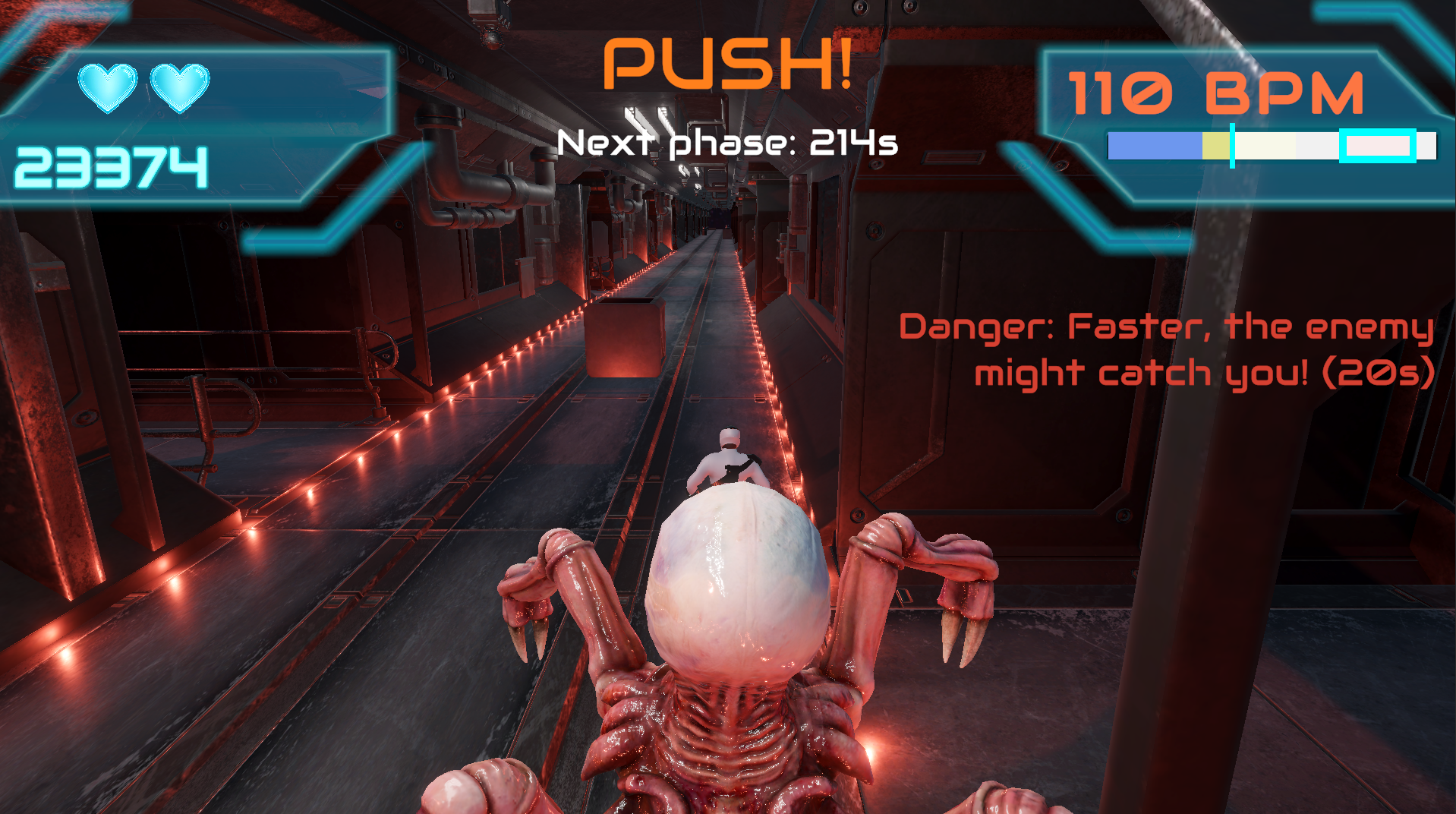
Let's be honest: running is exhausting, and on a treadmill it's often just plain boring. So we asked ourselves "What if running actually felt like a matter of life and death?". Meet Alien Runner: a heart-pounding mashup of Subway Surfers and Dead Space. You are in a futuristic setting, you have just broken out of the alien lab, and the aliens are right behind you. The only way to survive: run. For real. On a real treadmill. The twist is, that your heart rate controls the game. Run fast enough to keep your pulse at the target zone, or the alien catches you. Dodge incoming obstacles by smashing the buttons mounted on the treadmill, or you'll lose your lifes. What the game delivers is not just a workout, but a survival mission.

What are you training for?
Our goal is to enable an exciting high-intensity interval training (HIIT) experience. The game consists of two alternating phases, Recovery and High Intensity, that mirror real interval training. HIIT is one of the most time-efficient ways to boost overall fitness and burn calories, making every run count.
What did players think?
We evaluated Alien Runner with 10 players using the PACES-S (Physical Activity Enjoyment Scale), the PXI (Player Experience Inventory) and a few open-ended questions. The participants rated the game as genuinely enjoyable to play while exercising, and, perhaps most importantly, everyone said it would motivate them to use the treadmill more often for running training. Players especially appreciated how the game distracted them from the physical effort of running, turning a demanding task into something engaging. The atmosphere and sci-fi design were praised repeatedly, and several participants highlighted that the difficulty felt self-adjusting, since your own pace and heart rate drive the intensity. The demand of switching lanes to dodge obstacles while running felt well-balanced overall, meaning it was challenging enough to stay engaging, without ever becoming overwhelming or too distracting. The main exception was the transition between Recovery and High Intensity phases, where adjusting treadmill speed and dodging obstacles simultaneously increased cognitive load for some, though one participant described this multitasking as fun. The received feedback also revealed further necessary improvements, e.g. automatic speed adjustment, more varied terrain, clearer hit animations and additional statistics after a run.
Project Team
- Juliane Plückhahn
- Ida Zabiensky
- Annika Rittmann
- Yannik Stahl
- Valeria Magdych
Runout: A Webcam Based Exergame Using Continuous Squat Depth
As part of the Interactive Game Development module in the winter semester 2025/26, our project is about a two dimensional side scrolling exergame in which the player controls the game character by squatting. We chose this approach because many exergames depend on motion controllers, depth cameras, or head mounted displays, which have to be acquired and set up before anyone can play, whereas Runout requires nothing beyond a standard webcam. A pose estimation process extracts the vertical position of the player's nose from the camera image and maps it onto the vertical position of the game character. The mapping is continuous rather than binary: the game calibrates the individual range of motion of each player, so a shallow squat moves the character a short distance and a deep squat moves it to the lower bound of the play area. Players control Kael, a winged sprite whose duty was to look after the magical maps that hold the realms together. He neglected it, the maps are now scattered across every world, and he is the only one who can retrieve them. Because the maps are distributed across the full vertical range of the play area, collecting them requires the player to move through their entire range of motion. Obstacles differ not only in the height at which they appear but also in how they move, so the composition of obstacles within a level determines the distribution of movements a player performs. The game currently comprises two worlds, a winter level and a jungle level. All obstacles and the player character were modelled and animated by us in Blender in a low poly style, and the scrolling backgrounds were generated with a text to image model.
Project Team
- Büsra Bugrahan
- Finn Eilmann
- Meryem Karakurt
- Niels Kirstein
- Marten Linge
Elements Boxing
Punch the Elements. Master the Moves.
Motivation and Introduction
For the Interactive Game Development (IGD) project in the summer semester of 2026, our group created Element Boxing, a VR game designed to teach basic boxing punches and combinations. Our main goal was to introduce non-boxers and beginners to basic boxing techniques through a fun gaming experience, while also giving more experienced boxers an entertaining and effective warm-up program. In Element Boxing, you take on the role of a student learning to bend the elements. Your master challenges you to complete three demanding stages. By overcoming them, you gradually learn to control and master all elements. Your task is to neutralize incoming elements by using the correct counter-element together with the required boxing punch. At the same time, you must dodge fireballs and block rock chunks. Correctly performed combinations and successfully dodged or blocked projectiles earn you points, while mistakes cause you to lose them. Will you achieve the highest score and master all the elements?
The Movement Concept
Gameplay is built around multiple boxing techniques, namely straight jabs, hooks, uppercuts, and blocks for both arms, along with dodging by ducking. The master Aluza calls out combinations using boxing punch-number notation, which players execute physically. This lets players train real boxing technique with full-body engagement while also learning the punch-number notation, no prior experience required.
User Study Results
In a study with ten participants, the in-game physical activity was rated as clearly enjoyable, with high scores for exercise enjoyment. Immersion and enjoyment were the most consistently positive aspects of the player experience. At the same time, the study revealed that punch tracking needs to become more reliable, and players expressed a desire for more autonomy and a brief onboarding tutorial, providing valuable insights for future improvement.
Project Team
- Bahar Barikzei
- Paul Mürre
- Alexej Nikulin
- Narges Ramezanzadeh
- Frieso Ritter
ShadowBeats
A music-driven Virtual Reality exergame about shadow boxing
Motivation
ShadowBeats is a rhythm boxing VR game with focus on techniqually correct boxing movements such as jab, cross, hook and uppercut encapsulated in a rhythm game framework fashioned after other well known VR titles.
The player is onboarded via a short but engaging tutorial to learn the boxings movement if they are unfamiliar to them and see their in-game representation as targets in a 3D space. The game loop then started by choosing a song-based level.
For game content generation we used a local algorithm to analyse a given .mp3 title and create a "beat map", increasing replayability. This information is then used to spawn random targets from the following move set at a random location in an 120° angle in front of the player:
- Jab (left or right)
- Cross (left and right)
- Hook (left and right)
- Uppercut (left and right)
- Base Stance (neutral boxing hand position)
- Block (hands at brows to protect the head)
- Evade (player is required to NOT get hit)
Player gesture recognition is realized using the MiVRy Unity addon. By recording a number of gestures for each move and training a local AI model to recognize provided samples, each movement is given an ID. Controller movements are then compared to the database and similarity is given as a value between 0 and 1, which is used for player performance feedback.
A streak based scoring system motivates the player to compete with themselves for better outcomes and technical improvement.
Physical Exercise
With sports as the given theme we explored several possibilities and came to the conclusion that professional boxing as a hand-to-hand combat sport was a fitting choice to combine with a VR application, since a headmounted display combined with handheld controllers engage exactly the two most crucial parts of the human body for boxing: hands and eyesight
The core game loop of ShadowBeats relies on continuous physical movement. The game is played standing upright in an open space with a headmounted display while wearing boxing gloves in order to hit ingame targets coming at the player. The wide spawn angle and rich movement set paired with obstacles that have to be evaded engage the whole body as well as reaction speed.
Shadow boxing is a common practice for professional boxers to enhance their movement execution form and physical fitness. A standard gaming session plays as a medium-intensity cardio workout tied directly to the rhythm of the selected song.
End-of-level reports give the player feedback on their performance and where to improve.
Project results & future work
The project resulted in a fully playable Unity VR application built for the Meta Quest. Key features include runtime beatmap generation, custom physical hitboxes for varied targets, a dynamic song selection menu, and an in-game scoreboard to track performance. The prototype is actively deployed in a user study to evaluate the physical impact and usability of the game's rhythm mechanics which were well received.
With the focus on techniqually correct execution of boxing movements the game would benefit from the following:
- Improvement of immediate and end-game feedback on the player's move execution/recognition and overall performance
- Representation of moves with intuitive icons instead of letters on targets to decrease player translation efforts and ease onboarding
- Larger diverse database for better gesture recognition, maybe with movement data from professional boxers
- (Online) Leaderboards to engage competitiveness and strife for mastery
- Better incorporation of calibration data such as player's height and arm reach
- Incorporation of main hand/footedness preference (orthodox vs. southpaw)
- Options to adjust difficulty such as target speed and spawn rate
Project Team
- Camila Chavez Lopez
- Hannah Rodenhäuser
- Philipp Schult
- Rithanya Rajeshkhannan
- Thomas Löhden
Kicker Party VR
A new approach to table football as an exervisive VR experience
Motivation
The premise of this project is to explore how virtual reality can enhance the traditional game of table football, making it more engaging and physically demanding. Our main inspirration lies in party games like Mario Party, which not only has a more light-hearted approach to gaming, but also encourages a wider audience of players to participate in the game, because of a broader set of challenges in each setting, so performance does not solely depend on the players' skill in one area, in our case table football. Conrectly, we implemented a set of mini-games, as well as special items that can be collected during the game to trigger special effects, which anhanced the experience of classic table football, which we ported as closekly as possible to the virtual environment. The players control the rods of the table in a familiar way by rotating and moving them using the Meta Quest 3 coontrollers.
Kicker Party VR aims to create a more physically engaging experience by incorporating real-world movements and gestures into the virtual environment. The game uses the unlimited space of VR to allow for more dynamic and physically demanding gameplay by adding two categories of interactive elements: items and mini-games. Items are triggered during play and briefly modify the game's rules or state by increasing ball speed, freezing rows of rods, awarding extra points via a special "punching" ball. They are primarily intended to create moments of surprise and fun. We also modified the size of the table in its length, which forces the players to move more and be more active, as they have to cover a larger area to reach the ball. Mini-games are time-triggered events that interrupt standard play and are specifically designed to get the player moving, reinforcing the exercise-game character of the experience. The game currently features three: in Dodgeball, balls are launched at the player, who must physically dodge them by moving out of the line of fire; in Smoke Alarm, pyrotechnics partially obscure the player's view, which must be cleared by waving a hand in front of the headset; and in Trash Throw, the player picks up cans and throws them into a bin beside the table, encouraging reaching, grasping, and throwing. Each mini-game demands a distinct form of physical activity, so players move in varied ways beyond the wrist and arm motions of the core gameplay, without becoming too exhausting for a general audience.
Results
We evaluated Kicker Party VR in a user study with ten participants (Mage = 27.7, SD = 2.79), who played the game for approximately six minutes and then completed a post-game questionnaire combining the Player Experience Inventory (PXI) and the short form of the Physical Activity Enjoyment Scale (PACES-S). Overall player enjoyment was rated significantly above the neutral midpoint (PXI Enjoyment, one-sample t-test, t(9) = 5.84, p < 0.001), together with high ratings for 'Clarity of Goals', 'Immersion', and 'Audiovisual Appeal', indicating that the game succeeded in engaging players on a perceptual and experiential level. Enjoyment of the physical activity component showed a positive trend (PACES-S mean = 3.62 on a 1-5 scale) that did not reach statistical significance at this sample size, though it correlated strongly with overall player enjoyment (rs = 0.77, p = 0.009), suggesting that improving one would likely raise the other. Notably, prior experience with physical table football was positively associated with both perceived Ease of Control (rs = 0.85, p = 0.031) and Mastery (rs = 0.84, p = 0.036) in the virtual version, indicating that real-world skill successfully transferred into the VR adaptation thanks to the one-to-one mapping of controller motion onto the foosball rods. Mastery received the lowest score among all subscales, and qualitative feedback pointed to control reliability, particularly grabbing the virtual rods and controller tracking precision, as the main source of this gap rather than the overall game concept. Participants most frequently praised the game's fun factor, immersion, visual quality, and the variety introduced by items and mini-games, while feature requests centered on more responsive controls, haptic feedback, and a multiplayer mode.
Project Team
- Clemens Wulff
- Niklas Prahl
- Kevin Langhain
- Jan Hummel
- Eric Spitz
PACE HEIST
BREAK YOUR PACE. BREAK YOUR COVER.
Motivation
Traditional running apps track distance, pace and time, but rarely give runners a real reason to keep coming back. With Pace Heist, we set out to change that: your real running route becomes the stage for a heist, where players take on the role of a thief who has to secure loot and outrun the police, driven entirely by their own running pace. The goal was to make outdoor running as gripping as a mobile game, while also helping players build stamina and speed along the way.
Sports Goal
Pace Heist is designed to motivate runners to consciously build and maintain their pace. The "Keep Pace" challenge requires players to hold a target speed for a set duration, while evading the virtual police forces additional sprint bursts. This combines structured interval training with game-driven motivation, building both endurance and speed without ever feeling like a traditional workout.
Results
We evaluated Pace Heist through self-testing on multiple real outdoor routes, followed by a study with 10 external participants who rated accuracy, difficulty and fun after the run via a post-run questionnaire. The feedback confirmed that the core loop (running, evading, and unlocking skills) works and feels engaging, but also revealed clear limitations: GPS accuracy was lower than expected, making smoothing essential rather than optional, and audio/haptic feedback proved far more effective than visual cues, since players rarely look at the screen while running. The prototype still depends on open outdoor space for testing and has only been validated with a small group of players so far.
Project Team
- Florina Ludwig
- Luisa Schendel
- Fynnian Brosius
- Robert Günzler
- Kendrick Häbel